


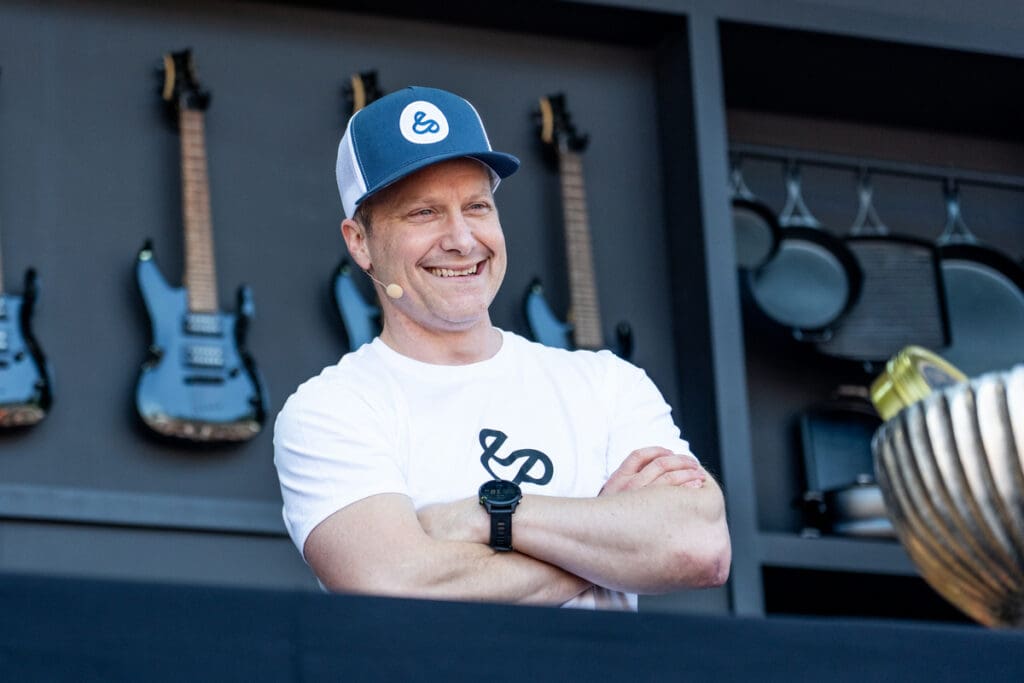
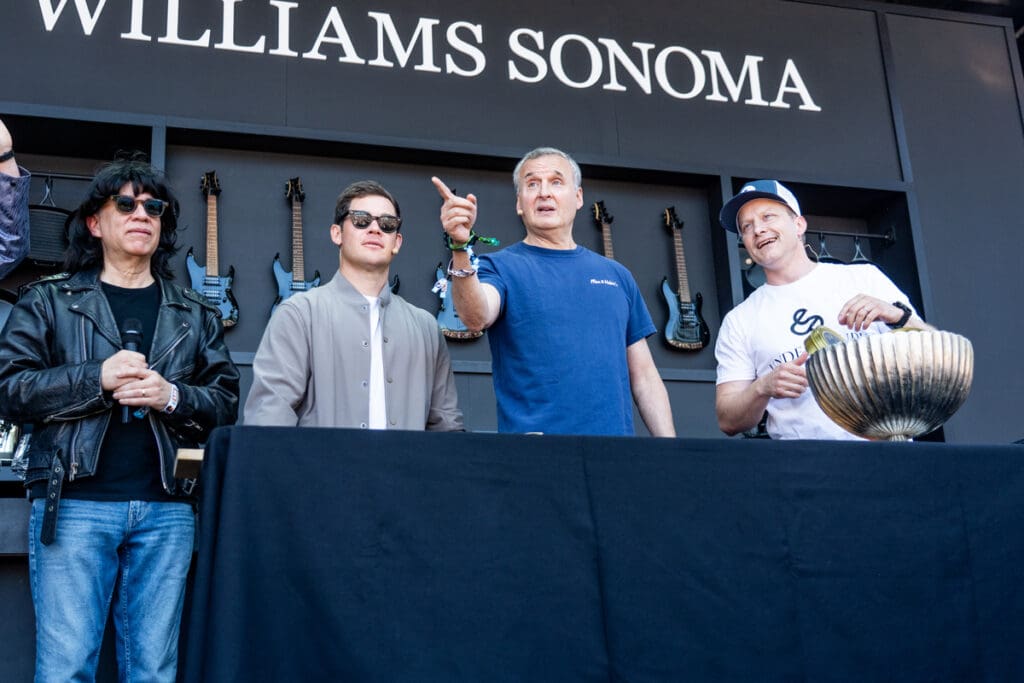
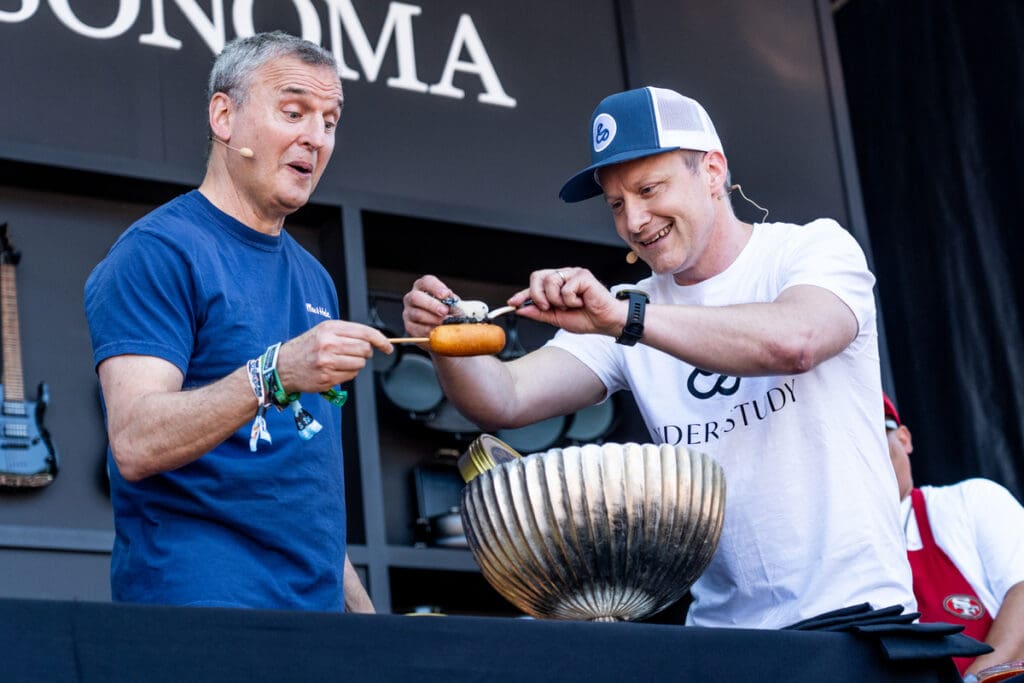
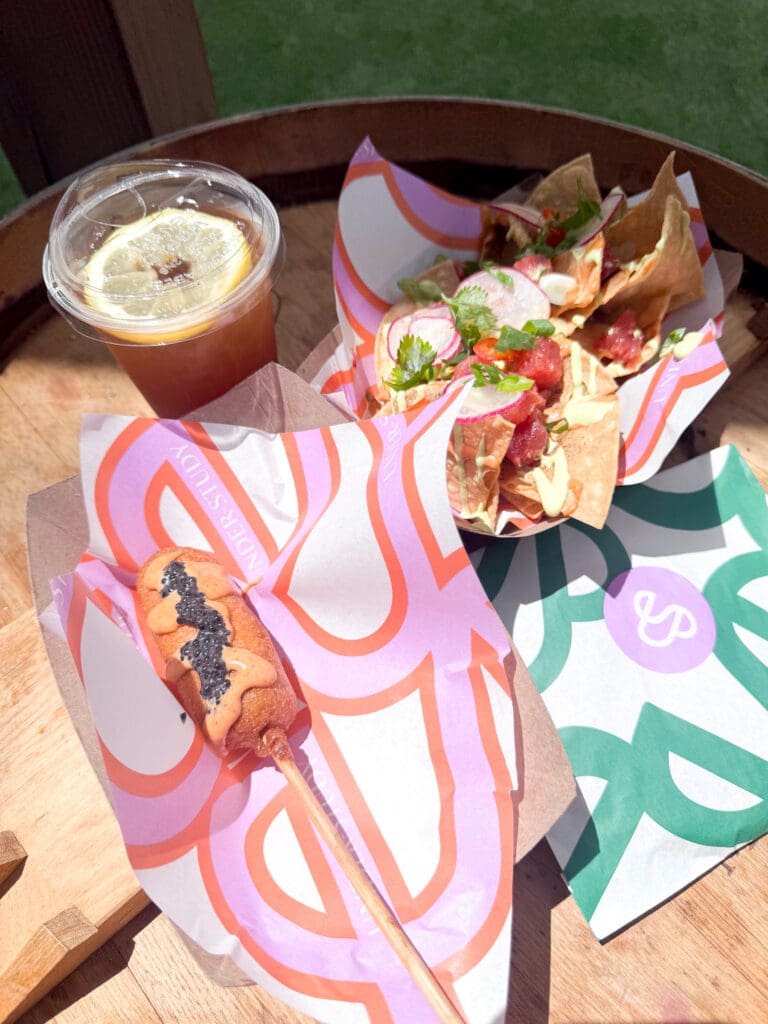
One of the standout moments on the Williams Sonoma Culinary Stage at came during chef Philip Tessier’s debut appearance. The acclaimed chef from Press and its sister concept Understudy joined an all-star lineup that included Masaharu Morimoto, Phil Rosenthal, John Stamos, Fred Armisen and Adam Devine. Tessier brought along one of the most sought-after bites at the festival: the now-famous lobster corndog topped with Tsar Nicoulai caviar, which has become a must-try item for BottleRock attendees.
Beyond the culinary stage, Tessier has helped establish Press as one of Napa Valley’s premier dining destinations, earning Michelin recognition while building one of the world’s most extensive collections of Napa Valley wines. We caught up with him at BottleRock to talk about his favorite Napa experiences, competing on television, the importance of community in wine country, and why thousands of people can’t seem to get enough of those lobster corndogs.
What’s your perfect bite of food?
That’s easy. A beautiful French cheese on a toasted baguette, sitting somewhere in France. That’s pretty hard to beat.
If you had a completely free day in Napa Valley, what would it look like?
I’d start by stopping at a bakery—obviously Understudy in St. Helena would be on the list. Then I’d head out for a hike before the fog burns off and get a view of the valley from above. If I had enough time, I’d visit a winery, which honestly doesn’t happen very often.
I love places like Morlet Winery, Schramsberg, and Continuum. They each offer something different from the traditional Napa Cabernet experience. Then I’d probably take a nap by the pool and do all the things I never actually get to do. To finish the day, I’d go have dinner at one of my friends’ restaurants.
Which restaurant are you choosing for dinner?
If I’m looking for a relaxing evening, I’d head to Charlie’s in St. Helena. They do a fantastic job and the atmosphere is always fun. If I’m looking for something more casual, probably Stateline Road Smokehouse down in Napa.
Fans are still talking about your appearance on America’s Culinary Cup. (We think it was a travesty with Chef Philip being cut on Episode 1) What stands out most from that experience?
The amount of support I’ve received afterward has been incredible. I had guests tell me recently they watched the show, got upset with how things played out, and immediately made a reservation at Press.
For me, the biggest takeaway was simply the adventure of it all. I had turned down television opportunities for years. The producers promised this would be different, and it definitely was. It wasn’t exactly what I expected, but once you’re there, you’re fully committed.
The best part ended up being the relationships. Chef Matt Peters and I became even closer through the experience, and now we’re coaching Team USA together for the Bocuse d’Or competition. What started as a television competition became something that strengthened friendships.
Is there a destination that changed how you think about food?
Madrid. I came from a very French fine-dining background, and Madrid completely shifted my perspective. The energy around food there is incredible. The tapas culture, the creativity, the way people interact with food—it felt fun and exciting. It reminded me that food doesn’t always have to be serious to be exceptional.
What’s the most memorable meal you’ve ever had while traveling?
Sitting down for dinner with Paul Bocuse at his restaurant in France. As a young cook, I remember standing outside that restaurant in complete awe. Years later, I found myself sitting at a table with him alongside Chef Keller and several other chefs. It was before I ever competed in Bocuse d’Or myself. That experience is something I’ll never forget.
How important is the collaboration between chefs, wineries, farmers, and hospitality businesses in Napa Valley?
It’s everything. I moved from New York City to Napa and quickly realized how interconnected this community is. Restaurants, wineries, hotels, farmers—we all rely on one another. COVID really highlighted that. It reinforced how important those relationships are.
If you’re going to build a restaurant in Napa Valley, you have to embrace the community. You can’t operate in isolation. Napa is built on tourism, but it’s also built on local relationships. Both are equally important. That’s one of the things I love most about working here.
Why should travelers make Press part of their Napa itinerary?
We talk every day about creating the quintessential Napa Valley dining experience.
If someone comes to Napa and doesn’t visit Press, we want them to feel like they missed something special. We have the largest collection of Napa Valley wines in the world, a beautiful dining room, and multiple ways to experience the restaurant.
Guests can enjoy a four-course menu, a seven-course tasting menu, or simply stop by for the bar and lounge offerings. We want the experience to feel elevated but approachable.
What role do Michelin stars still play in today’s dining landscape?
Michelin is still the benchmark. People have opinions about Michelin, and that’s fine, but it’s still incredibly important. It helps drive business, especially for travelers visiting a city for the first time.
It’s also aspirational. Chefs want to reach that level. Beyond that, Michelin recognition helps attract talented team members. When people are deciding where they want to work, those distinctions matter. We always want to attract the best team.
If you were celebrating a major career achievement with a Napa wine, what bottle would you open?
I’d probably choose a 1979 Mondavi Cabernet. I actually tasted one recently, and it was extraordinary. It’s also my birth year, so it has some personal significance. We have some incredible older vintages in our cellar, and it’s fascinating to see how those wines have evolved over time.

You made your Williams Sonoma Culinary Stage debut this weekend. What was that experience like?
It was a blast. Getting to share the stage with people like Phil Rosenthal, Morimoto, Eddie Chavez, and the rest of that group was really special. That’s what makes BottleRock unique—it brings together chefs, musicians, actors, and personalities from all different worlds.
The energy was incredible, and it was a lot of fun being part of it.
We have to talk about the lobster corndog. How many have you sold this weekend?
A lot more than we expected. Our first year at a festival we sold around 750 over three days. Last year we made 2,700 and sold out halfway through Sunday. This year we started with 4,000 and still had to make more. We’ll probably end up around 4,300 by the time the festival wraps up. It’s become one of those things people feel like they have to try when they come to BottleRock.
What started as something fun has turned into one of the festival’s signature dishes. The best part is that people don’t have to wait until next year’s BottleRock to get one. It’s on the menu every day at Understudy in St. Helena, so anyone experiencing a little BottleRock FOMO can come find us there.
You’re hosting educational culinary events throughout the year as well at the Understudy Culinary Lab. What can visitors expect?
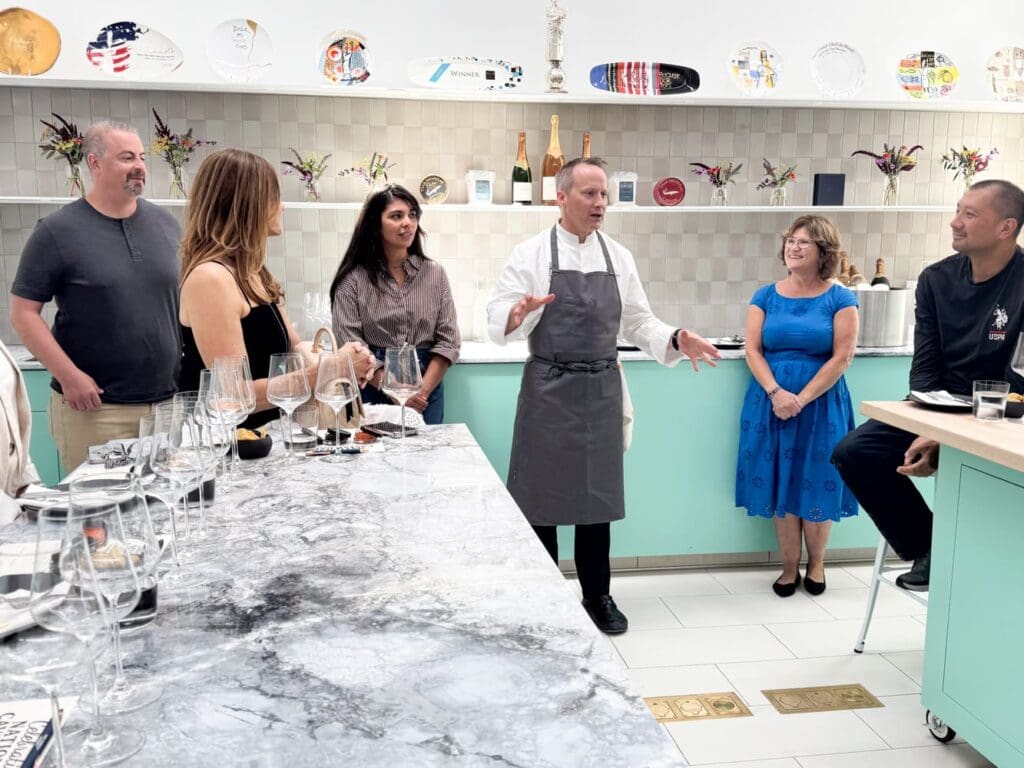
We’re expanding our classes this summer. We’ll have everything from focaccia-making workshops and pasta classes to charcuterie and cheese tastings. But we really try to educate people on quality and craftsmanship, helping them understand the differences between products and techniques.
Some classes are hands-on, some include lunches, and we’re also launching a Friday evening series. It’s a great way for visitors to experience Napa beyond wineries and restaurants.
After 18 years in Napa Valley, what keeps you here?
I originally moved here for two years. That was 18 years ago. The quality of life is hard to leave. I loved New York, but once my daughter was born, I knew Napa was where I wanted to raise my family.
The ability to wake up, look out at the hills, and instantly feel connected to nature—that’s something special. It’s a big reason why so many people come here for a visit and end up staying much longer than they planned.