


What connects a musician standing on a concert stage, a skier carving a line down a mountain and a filmmaker capturing an athlete moving through a landscape?
For Jim James, Chris Benchetler and Ross James, the answer is creativity—and the mysterious force that allows an artist or athlete to lose themselves completely in the moment.
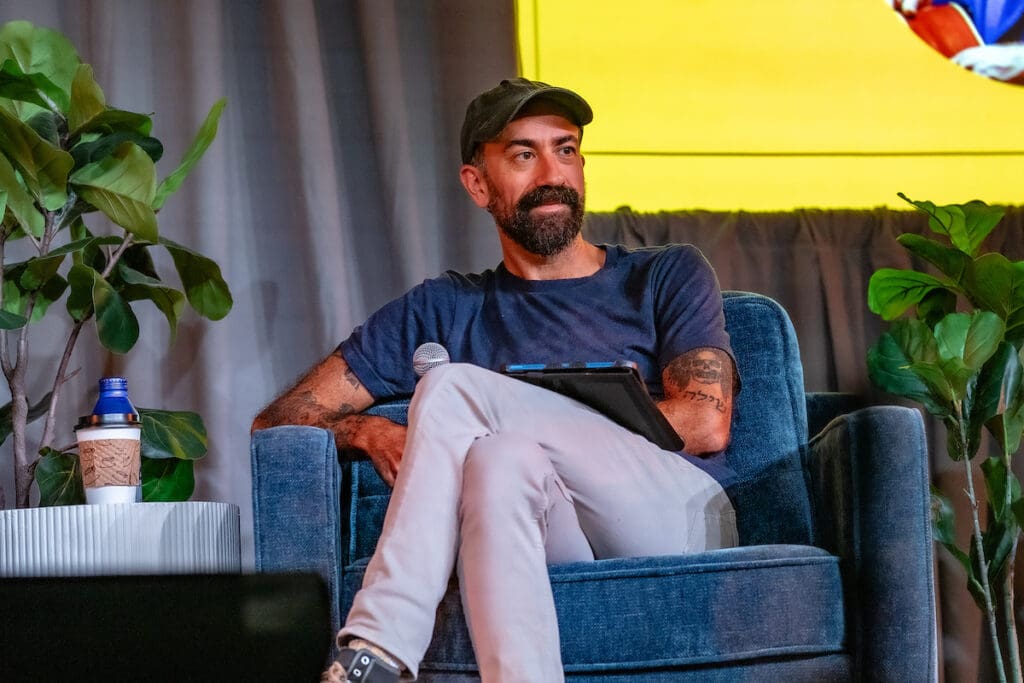
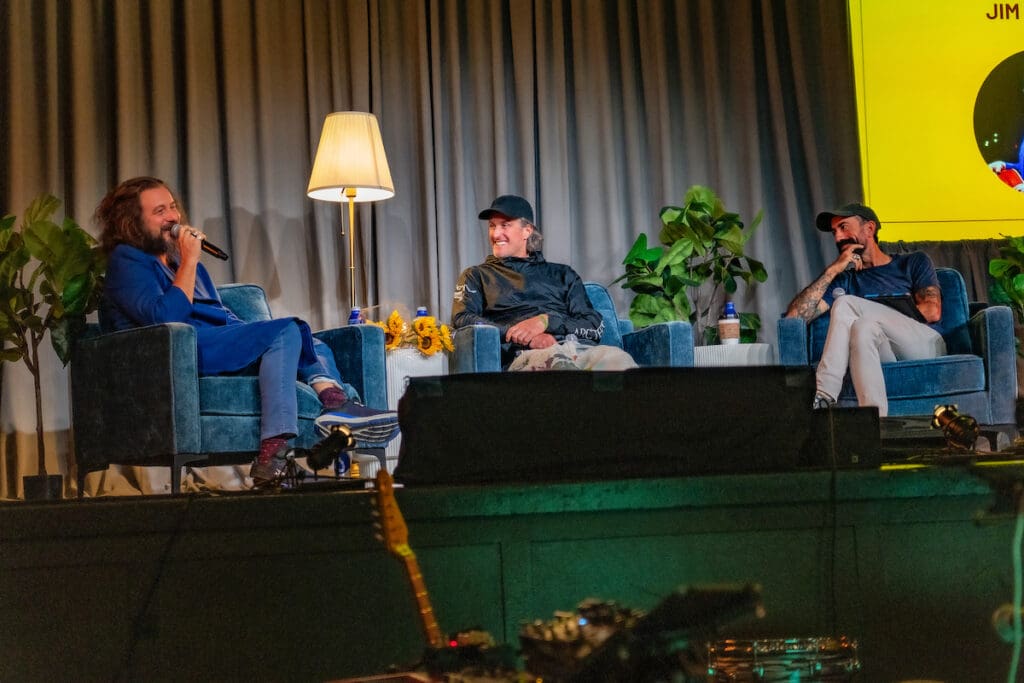
That idea was at the heart of “The Creative Thread: Connecting Sound, Film, Sport and Story,” a Summit Lab conversation at Park City Song Summit featuring My Morning Jacket frontman Jim James, professional skier, filmmaker and artist Chris Benchetler, and musician Ross James.
The conversation moved easily between music, visual art, skiing, filmmaking, technology and the natural world. While James and Benchetler come from very different creative disciplines, both described a similar experience: the most meaningful work happens when they stop overthinking and allow themselves to enter a state of flow.
Immediately following the conversation, the audience got to see that philosophy in action with a screening of Benchetler’s outdoor sports film, Mountains of the Moon.
The film was live-scored by a band featuring Eric Krasno on guitar, Ross James on bass, Alex Koford on drums, Holly Bowling on keyboards, and Nicki Bluhm and Ben Anderson on vocals. The musicians recreated the film’s soundtrack entirely with songs from the Grateful Dead’s live repertoire, creating an immersive combination of film, music and outdoor adventure.
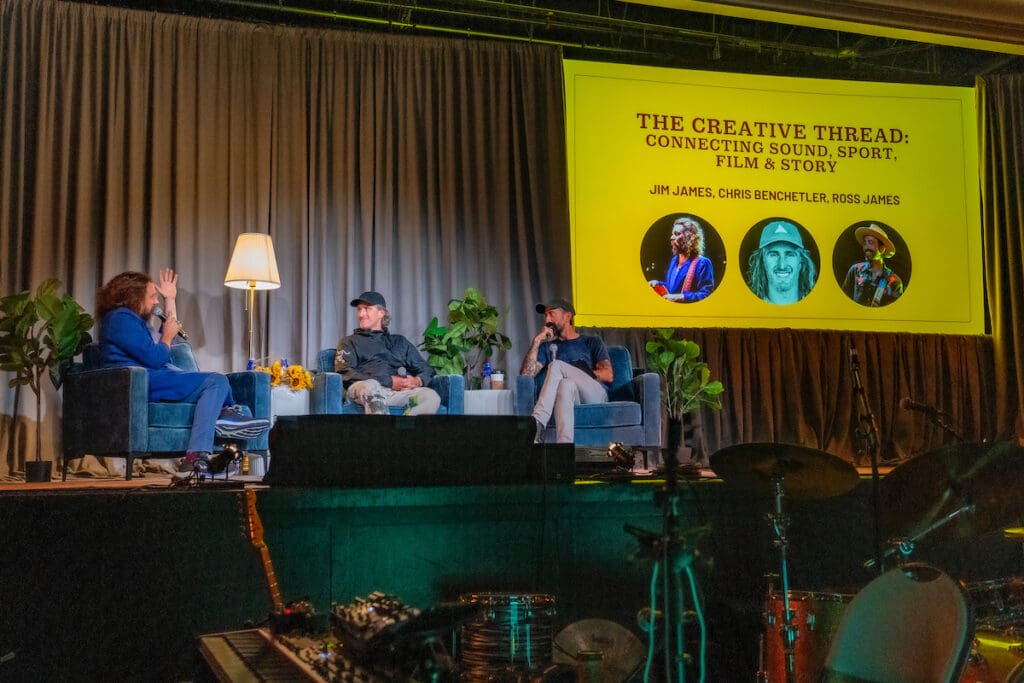
Finding Inspiration Beyond Music
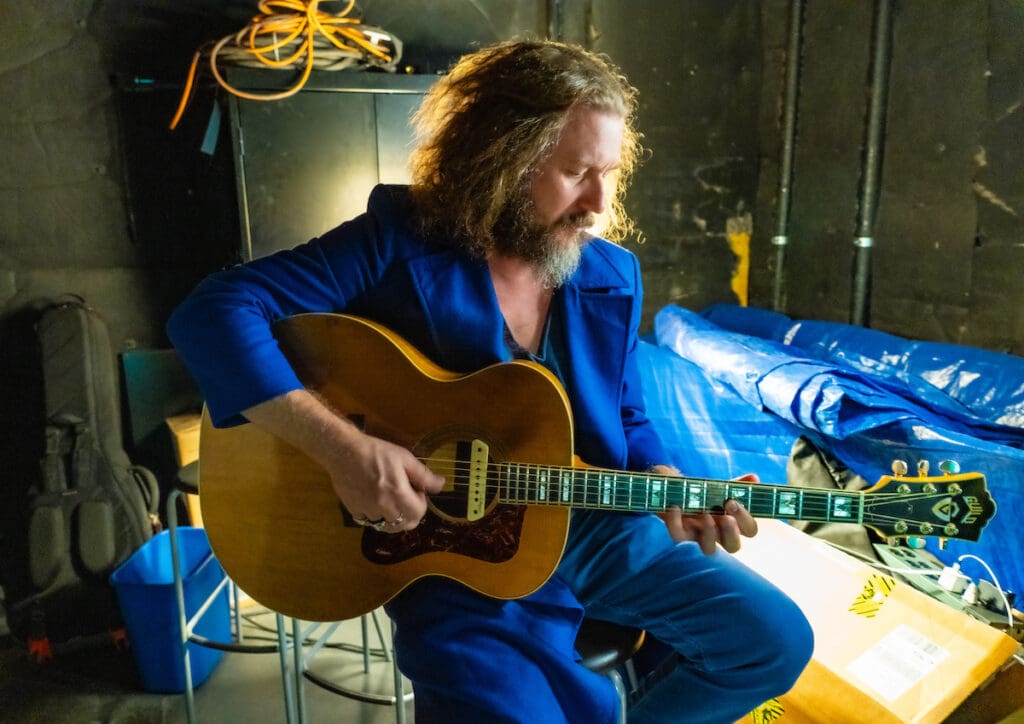
For Jim James, inspiration has never been limited to music. The My Morning Jacket singer and songwriter told the Summit Lab audience that one of his favorite things to do while touring is visit local art museums. He sees a direct connection between the way visual artists create and the way musicians approach their work.
James compared songwriters such as John Prine and Joni Mitchell to masters of realism, while describing his own approach as closer to abstract art. “I feel like I’m the throw the paint all over the canvas kind of guy,” he explained.
That is part of what draws him toward modern and abstract art. James said he loves the idea that two people can stand in front of the same painting and see completely different things. Music works in much the same way.
For him, a song doesn’t necessarily need to have a single obvious meaning. Sometimes the spirit of the music simply tells him when a piece is finished. That openness to interpretation is one of the qualities that makes art powerful. A song, painting or film can become something different for every person who experiences it.
A Mountain Is a Blank Canvas
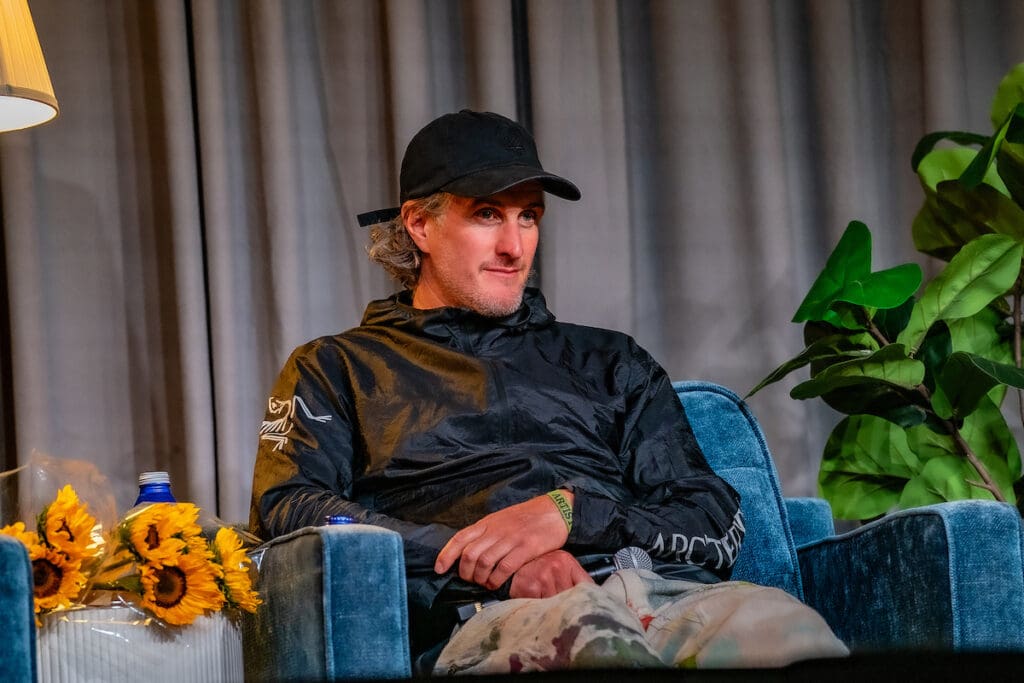
Chris Benchetler approaches creativity from a very different physical environment, but his philosophy is remarkably similar. As a professional skier, filmmaker and visual artist, Benchetler sees the mountain itself as a blank canvas.
“I do paint physical paintings, I make films, I ski professionally,” he said. “And so a mountain canvas is a blank canvas and being able to draw lines and all of that.” Skiing gives him a way to physically interact with the landscape, drawing lines across snow in much the same way a painter draws across a canvas. But music is the thread that connects many of his creative pursuits.
His films are built around music, and he described music as a way of connecting to something deeper. “The earth is the ultimate rhythm machine,” he said. That connection to nature has influenced the way Benchetler approaches not only skiing but also filmmaking, painting and storytelling.
As his musical tastes developed, he became particularly drawn to music from the 1970s—a period that continues to influence his creative work. For Benchetler, artists in every medium are essentially building on what came before them. He described the process as “sitting on the shoulders of giants,” taking inspiration from the artists and creators who came before and using those influences to create something new.
Getting Into the Flow
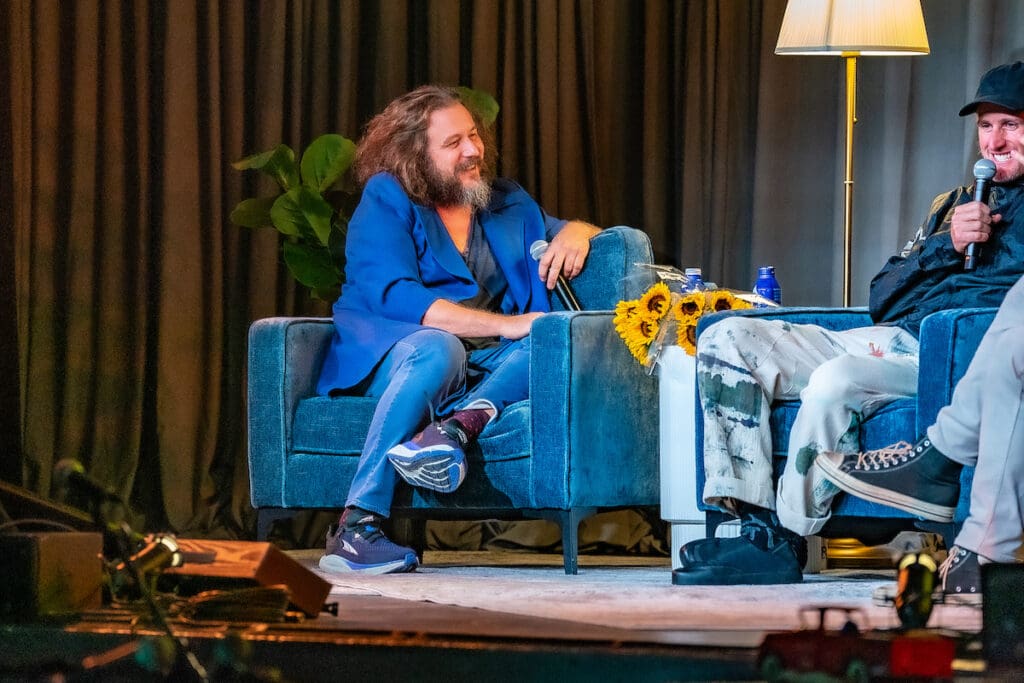
One of the most compelling parts of the Summit Lab conversation was the discussion of what happens when artists enter a true creative flow.
Ross James, acting as the moderator of the talk, referenced a familiar idea from Grateful Dead history: the best performances are the ones where musicians aren’t simply playing, but feel as though they are being played.
James immediately connected with that idea. For him, the worst performances are the ones where he becomes overly conscious of everything around him—the guitar being out of tune, the sound being too loud or other technical distractions. The goal is to move beyond that awareness and become completely immersed in the moment.
James described it in almost spiritual terms, talking about the relationship between humanity, nature and the larger universe. He compared individuals to waves in an ocean: each person is unique, but everyone is also part of something much larger. Those moments of complete immersion—whether in music, painting or another creative discipline—can feel like temporarily stepping outside ordinary human consciousness.
Benchetler agreed. For him, the key is being present and allowing the moment to take control. “Letting the moment control the moment,” he said. It is a deceptively simple concept, but one that applies across every creative discipline represented in the room.
Doing Things The The Hard Way
That idea of surrendering to the creative process doesn’t mean the work itself is easy. Benchetler’s latest film, Mountains of the Moon, was four years in the making and brought together virtually every outdoor sport that has shaped his life, including skiing, surfing, snowboarding, climbing, mountain biking and freediving. The film is essentially an extension of his mind and his experiences.
At its center is the idea of connection, inspired in part by mycologist Paul Stamets and the interconnectedness of living things through mycelium. Benchetler also made a deliberate decision to create the film without relying on visual effects or artificial intelligence to manufacture the experience.
Instead, he wanted to create the images physically and in-camera. The film was shot primarily at night so Benchetler could control the light in the landscape. Rather than allowing the sun to dictate where and how the athletes could ski, he wanted to “paint” landscapes of light, using contrast, color and illumination to transform the mountain. Athletes became part of that visual composition.
Benchetler and his team turned them into glowing, LED-lit figures moving through the landscape like living brushstrokes. The production required generators, lights, ropes, climbing equipment and dozens of people working together. Over the four-year process, hundreds of people contributed to making the project possible.
It was a physically demanding, painstaking approach. And that was exactly the point. Benchetler said the team deliberately chose the difficult route rather than relying on shortcuts.
Jim James on AI: What Happens to the Human Artist?
The conversation naturally turned toward artificial intelligence and the growing role of technology in music and film. James had a complicated reaction.
On one hand, he acknowledged that AI is becoming increasingly powerful and that some of its implications are difficult to predict. On the other, he questioned why so much attention is being given to artificial intelligence when countless super talented human artists are still struggling to be heard.
His concern isn’t simply technological. It is philosophical. Why would an artist willingly give up the experience of creating something personal and meaningful? James joked about the absurdity of typing a request into a computer asking it to create a song that sounds like a combination of completely different artists.
But then he admitted that AI can also be unsettlingly impressive. He told the audience about hearing what he believed was a 1970s soul band performing an extended, horn-heavy, psychedelic version of AC/DC’s “Back in Black.” He loved it. Then he discovered it had been created by AI. That realization complicated his argument.
What happens when something created by artificial intelligence genuinely sounds great? It is a question the music and film industries are only beginning to confront.
Why Live Art Still Matters
For the panelists, however, the live experience remains something technology can’t easily replace. Ross pointed to concerts as one of the places where social divisions can disappear. People with completely different backgrounds and opinions can stand next to each other at a concert and share the same emotional experience.
Benchetler sees that same potential in film and art. He emphasized that his creative work begins with himself. He isn’t making art primarily to please an audience. He creates because he needs to create. If other people connect with it, that’s a bonus. That philosophy became especially meaningful when Mountains of the Moon was screened immediately following the conversation.
Mountains of the Moon: Film Meets the Grateful Dead
The transition from the Summit Lab conversation to the film screening felt almost like watching the ideas discussed onstage come to life.
Mountains of the Moon combines the physical intensity of outdoor sports with Benchetler’s visual-art sensibility, moving through spectacular mountain landscapes and sequences featuring skiing, mountain biking, rock climbing and other adventure sports.
The film itself is visually striking, but the experience became something much larger with the live score. Onstage, Eric Krasno handled guitar, Ross James played bass, Alex Koford was on drums, Holly Bowling played keyboards, and Nicki Bluhm and Ben Anderson provided vocals.
Instead of simply playing an accompanying soundtrack, the musicians recreated the film’s musical world entirely through songs from the Grateful Dead’s live repertoire. The result was a unique marriage of two forms of improvisational expression. The images moved across enormous mountain landscapes while the band interpreted the Dead’s music in real time.
For the audience, it created a different way of experiencing both the film and the music. A ski line became a musical phrase. A mountain bike sequence became part of a larger rhythm. Rock climbing and other moments of physical movement seemed to interact with the musicians onstage. The effect was immersive, energetic and at times almost hypnotic.
Having the music performed live also emphasized one of the central themes of the Summit Lab discussion: art changes when it is experienced in the moment. The audience wasn’t simply watching a finished film. They were watching the film while a group of musicians responded to it in real time.
The Creative Thread
By the end of the Summit Lab session and Mountains of the Moon screening, the connection between sound, sport, film and story was clear. The mediums may be different, but the creative process shares a common thread. It begins with curiosity. It requires experimentation. It often involves failure.
And eventually, if the artist is lucky, there comes a moment when conscious thought falls away and the work seems to take over.
For James, that moment happens through music and visual art. For Benchetler, it can happen while skiing down a mountain, painting, filming or building a massive outdoor production. For the musicians accompanying Mountains of the Moon, it happened through the spontaneous language of live performance. And for the audience, it happened in the space between all of them.
Park City Song Summit is built around the idea that music can be a gateway into larger conversations about creativity, wellness, culture and human connection. “The Creative Thread” demonstrated exactly why those conversations matter.
Whether it is a guitarist finding a song, a skier drawing a line through fresh snow, a filmmaker shaping light on a mountain or a band reinventing a Grateful Dead classic in front of a live audience, the underlying impulse is remarkably similar.
Create something. Follow the feeling. Get out of your own way. And see where the moment takes you.