


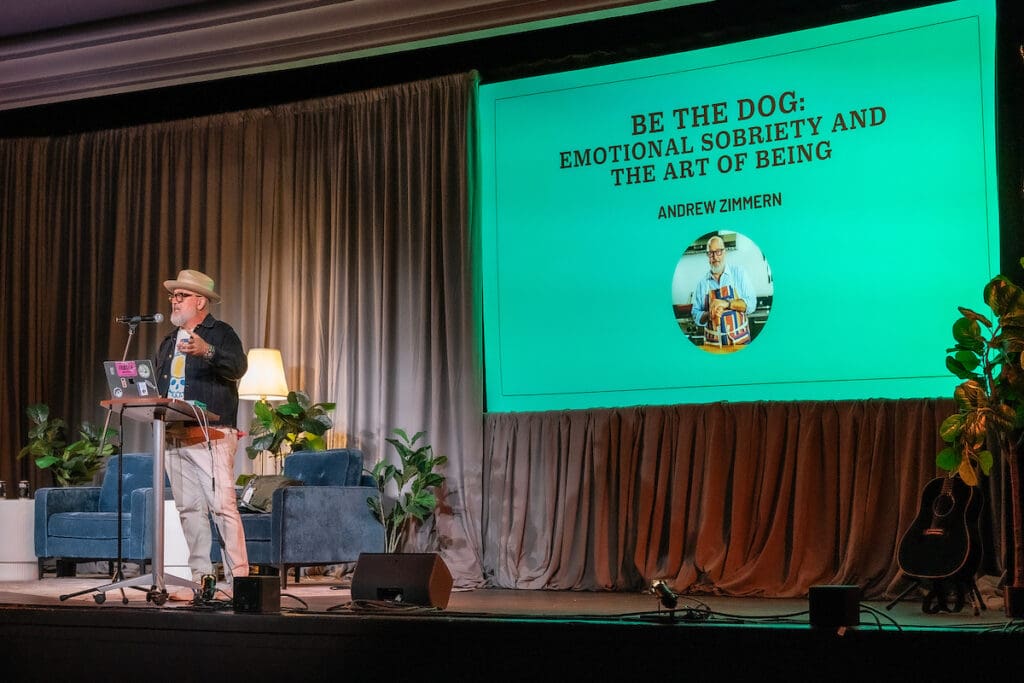
At Park City Song Summit, the conversations often go far beyond music. The annual gathering brings together artists, chefs, mental health advocates and storytellers to explore the connections between creativity, wellness and the human experience. During this year’s summit in Park City, Utah, television personality and chef Andrew Zimmern took the stage for a deeply personal Summit Lab titled “Be The Dog: Emotional Sobriety and The Art of Being.”
Zimmern’s talk was part memoir, part lesson in empathy and part challenge to rethink how we interact with the people around us. Drawing from more than three decades of sobriety, his experiences as a parent and his ongoing work in recovery, he explored what it means to become emotionally sober—and why sometimes the best thing we can do for another person is simply be there.
His central message was deceptively simple: Be the dog.
Sobriety Is Only the Beginning
Zimmern began by explaining why the subject is so personal. He has been sober for 35 years and described recovery as one of the biggest shifts of his life. But sobriety didn’t instantly solve everything.
At five, 10 and 15 years sober, he said, he was still struggling. His life had improved dramatically—he could build a career, participate in life and experience moments of happiness—but he continued making mistakes in his relationships and behavior. Eventually, he realized that simply stopping drinking and using substances was only the beginning.
“Not drinking and not using did not automatically make me a healthy human being,” he said. “It made me a human being who wasn’t drinking or using. And those are not the same thing.”
Zimmern began exploring what he calls emotional sobriety: the ability to address the behaviors that once served the same purpose as drugs and alcohol. Could he stop trying to control situations? Stop needing to be right? Stop fixing people? Stop turning every conversation into an opportunity to demonstrate what he knew?
For Zimmern, those questions became the real work of recovery.

What Does It Mean to Be Happy?
One of the larger questions Zimmern wrestled with was happiness. He spent years trying to understand what it actually meant. Happiness, he concluded, isn’t simply pleasure, success or getting everything you want. It isn’t the absence of suffering, either.
Instead, Zimmern described happiness as being fundamentally at peace with the life you’re actually living while remaining connected to other people and something larger than yourself.
That definition brought him back to relationships. He referenced the famous Harvard Study of Adult Development, which has followed participants for more than eight decades. One of the study’s central findings is that the quality of our relationships has a profound impact on happiness and health.
For Zimmern, that raised another question: How do we become better at relationships? The answer, he discovered, began with empathy.

Learning What Empathy Really Means
Zimmern had long considered himself an empathetic person. But as he learned more about empathy and vulnerability, he realized that much of what he had considered empathy was actually something else.
He was a fixer. If someone had a problem, he had an answer. If someone was struggling, he knew what they should do. If someone shared a difficult experience, he could immediately relate it to something that had happened to him and recommend a book, restaurant, doctor or podcast.
He eventually realized that wasn’t empathy. It was what he calls “operationalizing.” “You hear distress and you interpret it as an assignment,” he explained.
The distinction became especially clear through his experience with his son. When his son was six, he sometimes struggled with severe emotional episodes. Zimmern tried everything he knew to calm him down—reasoning, bargaining, threatening, persuading and trying different parenting techniques. None of it worked.
Then one day, Zimmern stopped trying to get his son out from underneath the bed. Instead, he lay down on the floor and put as much of himself underneath the bed as he could. He didn’t try to fix anything. He simply stayed there. Eventually, his son looked at him and asked what he was doing. “I’m just hanging out,” Zimmern told him. After several minutes, his son began to calm down. Eventually, they talked, went for a walk and had dinner together.
Zimmern hadn’t solved the problem. He had simply joined his son where he was. That moment changed how he thought about empathy.

The Dog Already Knows
Zimmern began thinking about the people and animals in his life who understood this idea instinctively. The answer was his dogs.
Imagine having the worst day of your life. You come home angry, exhausted and overwhelmed. You collapse on the couch. What does your dog do? It comes over and sits beside you.
It doesn’t give advice. It doesn’t tell you everything happens for a reason. It doesn’t compare your problem with somebody else’s. It doesn’t send you a podcast or explain what you should have done differently. It simply stays. “The dog does not try to fix me,” Zimmern said. That became his metaphor for emotional sobriety.
Be the dog.
Co-Regulate Before You Operationalize
Zimmern described the concept he now practices as “co-regulate before you operationalize.” In other words, connect before trying to solve.
If someone you love is upset, don’t immediately offer a solution. Don’t assume they haven’t already considered the obvious answer. Don’t turn their distress into a problem you’re responsible for fixing. Instead, listen.
Maybe offer a glass of water. Sit beside them. Put down your phone. Ask what happened. Say, “That sounds awful.” Then wait. If the person wants advice, they may eventually ask for it.
Zimmern shared a humorous example from his first marriage. His former wife once came home furious because she had lost her phone. Zimmern immediately suggested that she call security at work to see if someone had turned it in. He thought he was helping. She reminded him that she was a grown woman and had already thought of that.
The problem wasn’t the advice itself. It was the timing. Zimmern had jumped straight to solving instead of first acknowledging how upset she was. “Sometimes there is no useful sentence,” he said. “Sometimes there’s nothing to be said.”

Presence Before Prescription
Being the dog doesn’t mean becoming passive or never offering advice. Zimmern stressed that there are situations where action is necessary. But most everyday interactions aren’t burning buildings. They’re people having difficult days. They’re exhausted spouses, frightened children, struggling friends, employees who made mistakes and people dealing with painful news.
In those moments, Zimmern believes we often rush toward fixing because fixing makes us feel better. Being present is harder. He began practicing a simple sequence: connection before correction, empathy before advice, presence before prescription.
Over time, he noticed something remarkable. He was upsetting people less. He became more comfortable with silence. He caught himself before offering unsolicited advice. He became more curious and less focused on proving that he had the answer. And he began to understand that being the dog wasn’t simply a communication technique. It was emotional sobriety.

A Practice, Not a Perfect Solution
Zimmern acknowledged that learning these behaviors doesn’t happen overnight. At one point, he literally repeated the word “pause” to himself to create space between a thought and an action. Eventually, the pause became more natural.
That’s why he considers emotional sobriety a spiritual practice. You practice it until it becomes a muscle. He also encouraged the audience to rethink the idea of mistakes. In a question-and-answer session, one attendee suggested thinking of mistakes as lessons rather than failures. Zimmern agreed. He said he no longer thinks of mistakes in quite the same way, but instead sees them as opportunities to learn. Sometimes those lessons hurt other people, he acknowledged, which means the next step is taking responsibility and asking what can be done to make things right. The language we use with ourselves matters.
The Art of Staying
Near the end of his Summit Lab, Zimmern returned to the people who helped him through recovery. They weren’t necessarily the people who gave him the best advice. They were the people who stayed. “They let me be a mess without making my mess about them,” he said.
That may be the simplest explanation of his entire “Be the Dog” philosophy. We don’t always have to fix each other. We don’t have to make someone’s pain disappear. We don’t have to have the perfect answer. Sometimes the most meaningful thing we can offer another person is our presence.
Zimmern has spent 35 years learning how to live without the substances he once relied on to change how he felt. Along the way, he discovered another kind of recovery: learning how to live with other people without constantly trying to change them. “Co-regulate before you operationalize,” he reminded the Park City Song Summit audience.
Presence before prescription. Connection before correction. Empathy before advice.
And, perhaps most importantly: Be the dog.
Sometimes staying is the most loving thing one human being can do for another.